Sertian
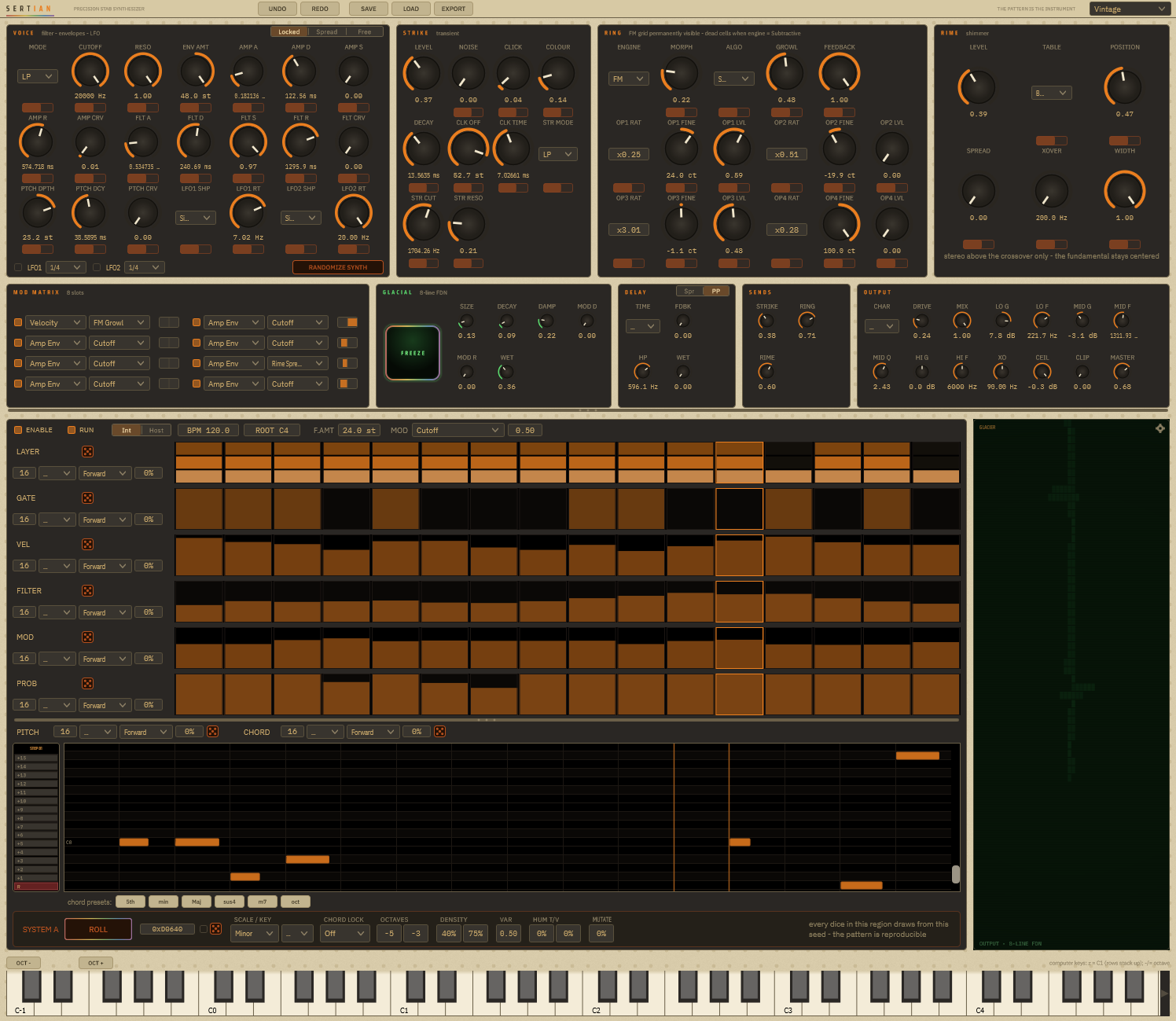
A precision instrument for stabs, chords and tuned percussion. Four distinct sound sources feed a Glacial reverb with an exact freeze, driven by a polymetric sequencer whose generated patterns are reproducible to the sample from a stored seed. The working principle, printed on the interface itself: the pattern is the instrument.
The percussive half of the record
Where Sentaris Bass holds the low end, Sertian handles everything that hits and rings above it: chord stabs, metallic tuned percussion, glassy plucks, and the long frozen tails that give dark electronic music its sense of space. It is built for producers working in industrial, hypnotic and dub-adjacent techno — people who need a stab that has a transient, a body, and a tail that can be held indefinitely without becoming a wash.
The instrument is designed around the idea that a stab is a composite event rather than a single oscillator. Four sources are always available and always visible, each responsible for one part of the sound.
Four sources, one event
Voice
The tonal core. A multimode filter with cutoff, resonance and bipolar envelope amount, driven by separate amplitude and filter envelopes with adjustable curve on each stage, plus a dedicated pitch envelope with its own depth, decay and curve — the control that turns a tone into a strike. Two LFOs, each with selectable shape and independent tempo sync.
Strike
The transient. A noise and click generator with its own colour control, decay, click offset and click timing, filtered through a dedicated multimode strike filter with its own cutoff and resonance. This is what separates a stab from a held chord: the first few milliseconds are synthesised independently of the body.
Ring
Four-operator FM. Selectable algorithm and engine mode, per-operator ratio, fine tuning and level, with feedback and a dedicated growl macro over the top. The operator grid stays permanently visible — cells grey out rather than disappearing when the engine is switched, so the layout never moves under your hands. This is the source of the metallic and bell-like content that makes a stab cut.
Rime
Shimmer. A wavetable source with selectable table and scannable position, detune spread, and stereo width applied only above a user-set crossover — the fundamental stays centred while the upper partials open out. Rime is what makes a stab feel wide without making it feel hollow in mono.
Glacial — an eight-line FDN with exact freeze
Sertian's reverb is a feedback delay network with eight lines, controlled by size, decay, damping, and modulation rate and depth. Its defining feature is the Freeze control: engaging it holds the network's contents exactly, with the feedback path at unity and the input closed. The tail neither decays nor accumulates. It sits there, unchanged, for as long as you leave it — and releases cleanly back into normal decay when you let go.
An exact freeze is harder than it sounds. A network that is even fractionally under unity fades over thirty seconds; fractionally over, it builds toward distortion. Getting it precisely right is what makes the control usable as a performance gesture rather than a novelty.
The reverb feeds a tempo-syncable delay with its own high-pass and mix, and both sit on a send architecture fed independently by the Strike, Ring and Rime sources, so the transient can stay dry while the tonal content is drenched. The output stage carries character, drive, a mid-band parametric section, high and low shelving, a crossover, ceiling and clip control.
Polymetric lanes and chord control
Seven lanes — layer, gate, velocity, filter, modulation, probability, pitch and chord — each with independent length, clock division, direction and swing. Because lanes are free to differ in length, the pattern realigns only at the least common multiple of their loops. An eight-step gate against a sixteen-step pitch lane produces a sequence that takes many bars to repeat.
Chord lane
Chords are sequenced as a first-class lane with its own length and division, alongside quick presets for fifths, minor, major, suspended fourth, minor seventh and octave voicings. Ghost notes on the roll show what the chord mask adds to the underlying pitch.
System A — pattern generation
The Roll macro generates a coherent pattern across all lanes from a stored seed, bounded by scale and key, chord lock, octave range, density floor and ceiling, variation intensity, humanize amounts for timing and velocity, and a mutate probability that lets the pattern drift over repeats. Every dice in this region draws from the same seed.
System B — synth randomization
Deliberately separate from pattern generation and visually distinct in the interface. Randomize Synth moves the sound, not the sequence, with a per-parameter amount so you can lock what you want to keep. Routing is not randomization — the modulation matrix is excluded on purpose.
Locked, Spread and Free
A three-position voice mode governing how simultaneous notes relate. Locked is the determinism guarantee: with the seed fixed, the instrument produces bit-identical audio output from the same input, on any machine and either platform. Every state carrier inside the voice snaps to target when idle, so nothing carries over between passes.
Bit-identical reproduction is unusual in a synthesizer, and it exists for a practical reason: it means a patch file carries the performance, not just the sound. Send someone a preset and they hear exactly what you heard — the same pattern, the same variation, the same result. It also means a render can be reproduced months later without a bounce sitting on a hard drive.
Everything visible at once
Sertian's layout is a single window with no hidden pages: all four sources, the eight-slot modulation matrix, the reverb and delay, the output stage, the full lane sequencer, the pitch and chord rolls and a playable keyboard are on screen simultaneously. The design premise is that a stab is built by adjusting several sources against each other, and that hiding any of them behind a tab breaks the loop between change and result.
The Glacier display along the right edge is a vertical output visualisation rendered as a phosphor trace — it shows what the reverb is doing over time, including the moment a freeze takes hold. The instrument ships in selectable visual themes.
Specifications
| Type | Stab and tuned-percussion synthesizer with integrated polymetric sequencer |
|---|---|
| Formats | VST3, Audio Unit (macOS), Standalone application |
| Windows | Windows 10 and 11, 64-bit |
| macOS | macOS 11 and later, Universal Binary (Apple Silicon and Intel) |
| Sound sources | Voice (subtractive core), Strike (transient), Ring (4-operator FM), Rime (wavetable shimmer) |
| Envelopes | Amplitude, filter and pitch envelopes with per-stage curve control |
| Modulation | Eight-slot bipolar matrix; two LFOs with independent sync; drift sources; velocity and keytracking; sequencer lanes as matrix sources |
| Reverb | Glacial — eight-line feedback delay network with size, decay, damping, modulation and exact Freeze |
| Delay | Tempo-syncable with high-pass and independent sends from Strike, Ring and Rime |
| Output | Character, drive, mid-band parametric, high and low shelving, crossover, ceiling and clip stage |
| Sequencer | Seven polymetric lanes with independent length, division, direction and swing; dedicated chord lane with voicing presets |
| Determinism | Locked mode — bit-identical output from a given seed, cross-platform |
| Validation | pluginval at strict settings; DAW testing across Ableton Live, Bitwig Studio, Logic Pro, FL Studio and Reaper |
| Status | Feature complete; in validation and sound design ahead of commercial release |