Sentaris Bass
A bass-specialist instrument built for deep, hypnotic, rounded low end — the dub techno and hypnotic techno lineage. Not a general-purpose synthesizer with a bass preset bank, but an engine whose entire signal path, modulation topology and default voicing are optimised for weighty, evolving, texturally rich bass.
Producers who already know the sound they want
Sentaris Bass is aimed at people working in hypnotic techno, dub techno and adjacent styles — the sonic territory of artists like Recondite, Maetrik, Maxim Dark and Carbon. The design brief was a specific list of adjectives: deep, clean, rich, layered, textured, rounded, hypnotic, evolving, weighty, never brittle. Every decision in the signal path was made against that list.
It is deliberately not a polyphonic pad or lead synthesizer, and not a sample-based instrument. It is monophonic and paraphonic, synthesis-first, and built to sit in one place in an arrangement and hold it.
A fixed three-layer voice
Rather than a blank modular canvas, Sentaris uses a fixed, purpose-named three-layer voice that mirrors how this kind of bass is actually built: a locked sub, a growling body, and a moving texture on top. Each layer is independently enabled and level-blended, and each can be driven by any of three synthesis engines.
Sub layer
Sine and triangle dominant, mono-forced and summed to centre, DC-safe. Owns the fundamental. Deliberately constrained — no stereo width — so the low end stays clean and mono-compatible on club systems.
Body layer
The harmonic core and the growl. Carries the low-mid weight. Typically subtractive with optional FM for density.
Texture layer
Movement and air. Decorrelated stereo width is permitted only above a user-set crossover, so the fundamental stays centred while the upper harmonics open out.
Subtractive engine
Two anti-aliased oscillators per layer with a single continuously morphing waveshape control — sine through triangle, saw, and pulse narrowing toward ten percent. Saw and pulse discontinuities are PolyBLEP-corrected; narrow pulse is DC-compensated so the sub path stays safe.
Wavetable engine
Bass-oriented tables chosen for organic, formant and harmonic-sweep character rather than aggressive EDM shapes. Scannable position with position modulation and unison spread.
FM growl engine
A compact operator section dedicated to controllable growl and low-mid density, with ratio-locked operators, feedback and a dedicated growl depth macro. Tuned for musical, tamable FM rather than clangy digital harshness.
Ladder filter, eight-slot matrix, drift
Zero-delay ladder low-pass
A topology-preserving-transform Moog ladder — four trapezoidal one-poles with the instantaneous feedback solved analytically, and a saturating nonlinearity in the feedback path for bounded, musical self-oscillation. Written by hand rather than taken off the shelf, so cutoff can be driven per-sample by envelopes, LFOs and sequencer lanes simultaneously.
Per-layer envelopes
Each layer carries its own filter and amplitude envelope. Segments use a one-pole response with attack overshoot for a convex analogue attack; retriggers start from the current level, so legato and fast repeats stay click-free.
Eight-slot modulation matrix
Sources and destinations are data tables rather than hardcoded routes. Per-layer destinations cover cutoff, resonance, oscillator pitch, morph and level, plus global destinations. Depths are bipolar and smoothed per-sample; deactivating a slot fades its depth to zero rather than cutting it.
Drift — smoothed randomness
A continuous random modulation source with cosine-interpolated targets and jittered segment lengths, so it never settles into an audible period. This is the source of the living, slowly-shifting quality the genre depends on — it is a stepped sample-and-hold's opposite.
LFO
Tempo-syncable or free-running, with multiple shapes including sample-and-hold. Its rate is itself a modulation destination, so drift can modulate LFO speed sample-accurately.
Glide
Last-note-priority legato glide with a legato-only toggle, driving all layers identically.
Five polymetric lanes
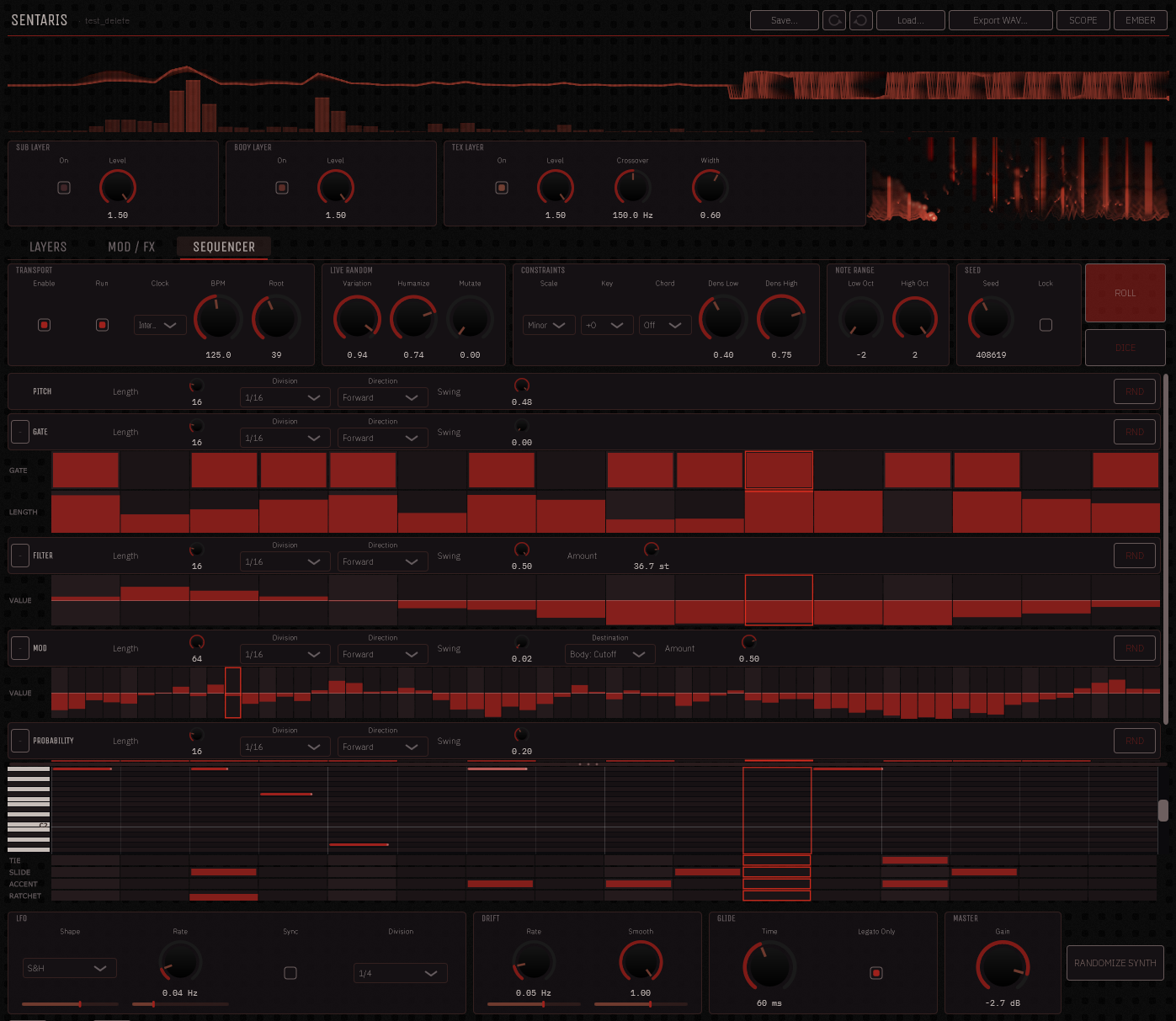
The sequencer is not an accessory bolted to a synthesizer. It occupies the largest area of the interface because this is a pattern-driven instrument. Five lanes run independently, each with its own length, clock division, direction and swing, so they realign only at the least common multiple of their loop lengths. Patterns evolve across bars instead of repeating.
- Pitch lane — note and octave per step, with rest, tie, slide, accent and ratchet count.
- Gate lane — the trigger master. Gate on/off and gate length per step; ties extend the gate through the following step.
- Filter lane — bipolar per-step cutoff offset, entering the voice as a smoothed modulation source rather than a stepped jump.
- Modulation lane — freely assignable to any destination in the matrix registry, with bipolar depth.
- Probability lane — per-step trigger probability, evaluated live so it never overwrites the stored pattern.
Sample-accurate host sync
In host mode every lane maps the transport position to its own step statelessly, which makes loops, relocations and tempo changes correct by construction. Starting playback at bar three plays the pattern in phase with the timeline. Steps fire at sample-accurate block offsets.
Tie, slide and ratchet
Slide overlaps the note stack to produce true legato with portamento and no amplitude retrigger. Tie extends the gate. Ratchet subdivides a step into evenly spaced retriggers with the gate length applied to the sub-step.
Roll — one button, one coherent pattern
The Roll macro generates a fresh bassline across every lane at once, respecting the scale, key, octave range and density targets you have set. Individual lanes have their own dice for regenerating in isolation.
Constrained by design
Every random control is bounded: scale and key lock, allowed note set, octave clamp, minimum and maximum density, and a master variation intensity. Humanize applies subtle timing and accent variation live rather than baking it in. Mutate gives any step a probability of subtly changing on each pass, so a loop drifts over time without losing its identity.
Seeded and reproducible
Generation draws from a stored seed. Lock the seed and the pattern is reproducible — the same patch produces the same bassline every time it is loaded.
Effects, export and interface
Bass-appropriate effects
Saturation in the voice path and a master stage; a mono-maker with adjustable crossover to keep the low end centred; a tempo-synced dub delay and reverb send with a high-pass on the send so it never muddies the sub; a three-band tone section with a dedicated low shelf; and a soft-clipping limiter on output.
Synth randomization, separately
A master Randomize Synth control moves the sound rather than the pattern. Every eligible parameter carries its own randomization amount, saved with the preset, so you can lock the parts you like at zero and let the rest move. Destructive targets are excluded by design.
Presets and WAV loop export
Patches save as versioned files carrying the full state including the sequencer pattern, validated on load so a corrupt file never replaces working state. Loop export renders offline at the exact musical loop length — computed as the least common multiple of all five lanes — with a choice of one, two, four or eight repeats, an optional tail so the delay and reverb ring out, and 16-bit, 24-bit or float output at 44.1, 48 or 96 kHz. The render is deterministic: the same patch exports identically every time.
Interface
A single dark window with the layer strip always visible, a live output seismograph under the header on every tab, a piano roll with drag-to-length editing that writes back to the gate and tie data, collapsible sequencer lanes, and draggable dividers whose positions persist with the patch. Full host automation across continuous parameters.
Specifications
| Type | Monophonic / paraphonic bass synthesizer with integrated step sequencer |
|---|---|
| Formats | VST3, Audio Unit (macOS), Standalone application |
| Windows | Windows 10 and 11, 64-bit |
| macOS | macOS 11 and later, Universal Binary (Apple Silicon and Intel) |
| Voice architecture | Fixed three layers — Sub, Body, Texture — each with selectable subtractive, wavetable or FM engine |
| Oscillators | Two anti-aliased morphing oscillators per layer, PolyBLEP-corrected |
| Filter | Zero-delay-feedback ladder low-pass per layer, self-oscillation capable |
| Envelopes | Filter and amplitude envelope per layer |
| Modulation | Eight-slot bipolar matrix, LFO, smoothed-random drift source, velocity and keytracking |
| Sequencer | Five polymetric lanes, 1–64 steps each, independent division, direction and swing |
| Signal path | Double precision throughout |
| Sample rates | 44.1–192 kHz |
| State | Versioned preset files including full sequencer pattern; deterministic offline WAV loop export |
| Validation | pluginval at strict settings; DAW testing across Ableton Live, Bitwig Studio, Logic Pro, FL Studio and Reaper |
| Status | Feature complete; in validation and sound design ahead of commercial release |